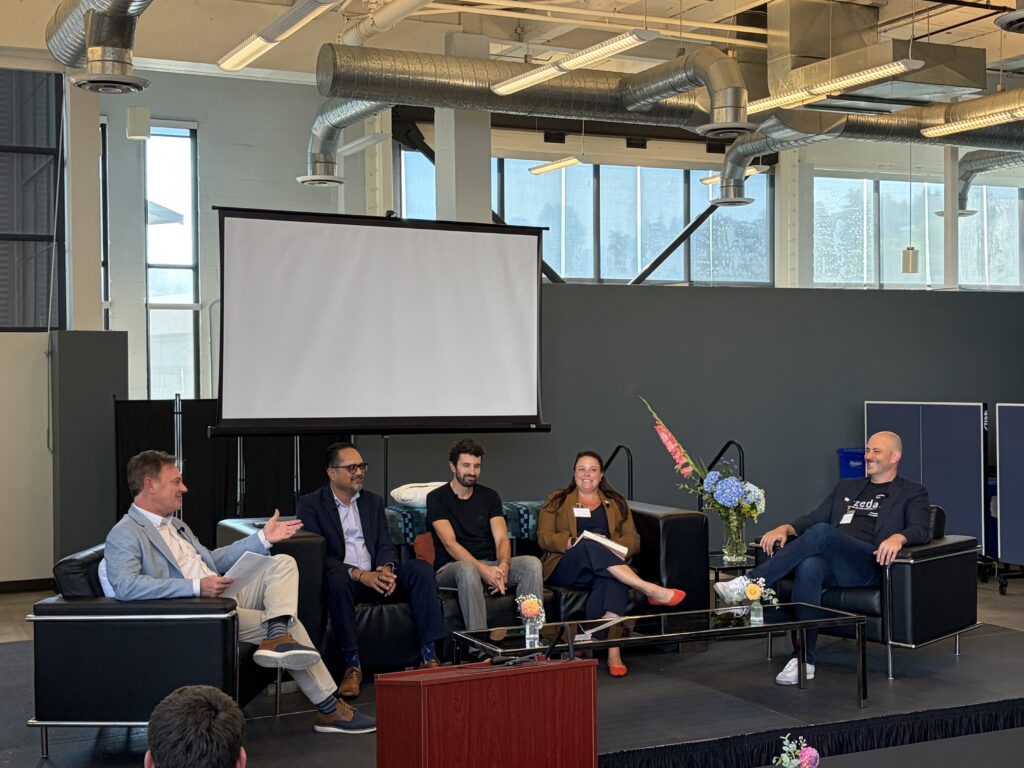
Last week, Life Science Washington, in partnership with Arzeda, hosted a Seattle field visit by the National Security Commission on Emerging Biotechnology (NSCEB) as part of its Biotech Across America Roadshow.
Established by Congress, NSCEB has spent the past several years examining what the United States must do to maintain its leadership in biotechnology, with particular attention to growing competition from China and the implications for U.S. national and economic security.
The Seattle visit brought Commissioners Paul Arcangeli and Alexander Titus together with Washington life science leaders for a tour of Arzeda and a discussion about how federal policy can better support U.S. biotechnology innovation and competitiveness.
Life Science Washington President and CEO Marc Cummings moderated a panel with Alex Zanghellini, Co-founder and CEO of Arzeda; Snehal Patel, EVP and CTO of Sana Biotechnology; Rebecca Bryant, Director of Government Relations at Fred Hutch Cancer Center; and Joe Horsman, Investor at Madrona Venture Group.
The conversation focused on issues familiar to companies across Washington’s ecosystem: federal research investment, access to capital, the challenges of moving from discovery to commercial scale, the growing convergence of AI and biotechnology, and increasing international competition for research, development and manufacturing.
The visit also gave local leaders an opportunity to speak directly with Commissioners about where federal policy and targeted investment can reinforce the strengths of regional biotech hubs like Seattle.
Read the GeekWire article here – As U.S.-China biotech race heats up, Seattle makes its case to D.C.
Read the WebProNews article here – Seattle’s Biotech Edge Faces a Three-Year Clock as U.S.-China Rivalry Intensifies
Turning the Commission’s Recommendations into Policy
NSCEB’s April 2025 final report, Charting the Future of Biotechnology, lays out 49 recommendations for strengthening U.S. biotechnology leadership. The Commission calls for at least $15 billion in federal investment over five years designed to mobilize significantly greater private investment.
Among the recommendations most relevant to Washington’s life science sector are proposals to strengthen SBIR/STTR and access to capital, streamline regulatory pathways, expand domestic scale-up and biomanufacturing capacity, improve access to biological data and infrastructure for AI-enabled research, and strengthen the biotechnology workforce.
The broader strategy is aimed at fostering competition without picking winners, countering competitors’ economic tactics, reducing barriers to biotechnology innovation and ensuring that U.S.-developed technologies can also be commercialized and scaled here at home.
Read the Commission’s final report and recommendations
What It Means for Washington
The Commission’s focus on U.S. competitiveness comes at an important moment for Washington’s life science sector. Federal research funding uncertainty continues to affect the research institutions and companies that anchor the innovation pipeline, while lower-cost research, development and clinical trial infrastructure overseas creates increasing competition for investment and jobs.
Those pressures also have implications beyond the industry itself. NSCEB warns that losing U.S. biotechnology leadership could ultimately leave Americans dependent on other countries for critical biotechnology products, including medicines.
“Seattle is a top U.S. life science cluster, built on world-class research, collaboration, and leadership in AI and life sciences,” said Marc Cummings, President and CEO of Life Science Washington. “Our ecosystem has delivered new medicines for patients, but federal funding uncertainty and lower-cost infrastructure overseas threaten U.S. leadership. Smart federal policy and targeted regional investments are critical to competitiveness, national security, and continued innovation for patients.”
From Recommendations to Action
Attention is now shifting from the Commission’s report to implementation. According to NSCEB’s July 2026 update, 36 of its 49 recommendations have seen bipartisan legislative action, 29 bipartisan standalone bills incorporating recommendations have been introduced, 26 provisions reflecting recommendations in whole or in part have been signed into law, and nine recommendations have been reflected in White House executive actions.
See NSCEB’s latest implementation update
For Life Science Washington, the Seattle visit was an opportunity to ensure that Washington industry perspectives are part of that implementation conversation. As Congress and federal agencies consider the Commission’s recommendations, LSW will continue advocating for policies and investments that strengthen the U.S. biotechnology ecosystem and ensure Washington remains a leading contributor to American innovation, competitiveness and national security.