On Friday morning, the Senate Health and Long-Term Care Committee heard testimony on SB 5981, legislation that would allow unchecked expansion of hospital contract pharmacy arrangements in the 340B Drug Pricing Program.
As we noted last week, SB 5981 is not a narrow technical fix. It would codify practices that allow hospital systems to use the 340B program as a revenue-generating tool, despite long-standing concerns about transparency and accountability and evidence that drug discounts are not improving access to care or lowering costs for patients. Those concerns were front and center during the committee hearing. Life Science Washington testified in opposition.
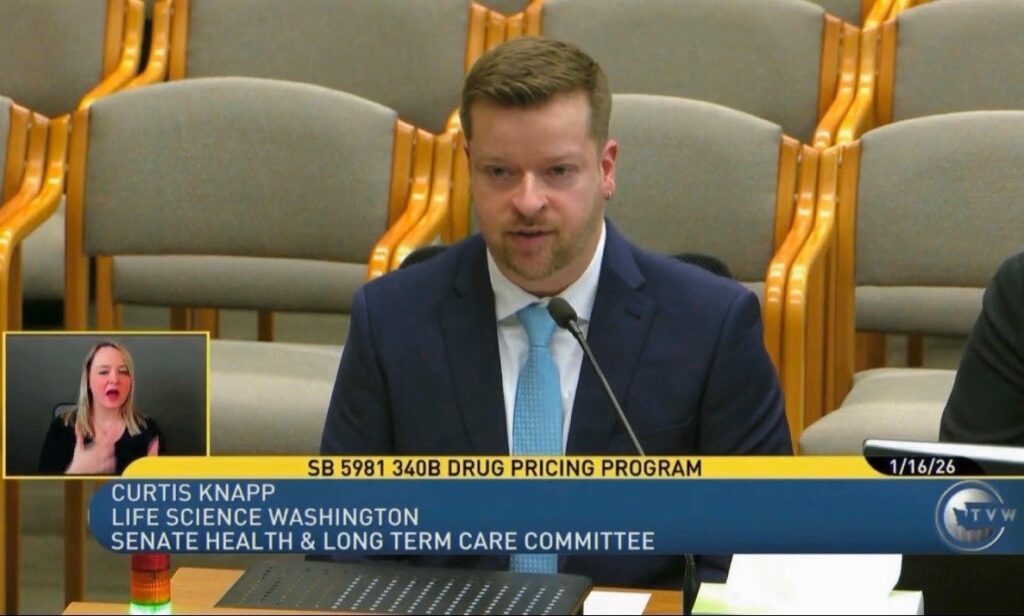
Watch our testimony here: https://tvw.org/video/senate-health-long-term-care-2026011162/?eventID=2026011162&startStreamAt=4812
Many biotech companies affected by this bill are not large pharmaceutical manufacturers with deep financial reserves. Small or mid-sized companies, often with only a single FDA-approved therapy on the market are still trying to fund clinical trials and reinvest revenue into the next generation of treatments. Requiring them to provide the same discounts and rebates as multinational firms, while hospitals retain the financial upside, directly reduces resources available for research and development.
Our testimony underscored that SB 5981 would further strain Washington’s Medicaid program. Federal law already prevents states from collecting Medicaid rebates on drugs dispensed under 340B, meaning every expansion of the program shifts costs onto the state budget without any guarantee of improved access or lower costs for patients. At a time when lawmakers are grappling with difficult budget decisions, this bill would move Washington in the wrong direction.
Finally, we raised concerns about how the continued expansion of contract pharmacy arrangements affects the broader healthcare ecosystem. The growth of hospital-centered dispensing and contract pharmacy networks disadvantages local, independent pharmacies and accelerates consolidation, often steering patients towards higher cost drugs and away from lower-cost community settings into more expensive hospital-based care without clear evidence of better outcomes.
The committee hearing reinforced a central issue with SB 5981: it prioritizes hospital revenue certainty over patient transparency, affordability, and long-term innovation. While hospitals are under real financial pressure, using the 340B program as a cross-subsidy without accountability was never the intent of the program, and it should not be cemented into state law.
Life Science Washington will continue engaging with lawmakers as this bill moves forward, advocating for policies that preserve patient access, protect the state budget, and ensure Washington remains a place where life-saving therapies can be discovered, developed, and delivered.